Skip to content

How a Simple Strategy in the Early 2000s Shaped My Long-Term Investing Mindset

  • by docdoc

I still remember those early years like they were yesterday. I was a young consultant physician—fresh into earning, balancing the realities of starting a family, and raising two small boys. Life was busy, uncertain, and exciting all at once. Every peso mattered. Every decision had weight. And like many young professionals at that stage, I wanted to give my family a stable financial future without compromising the work I loved.

Back then, savings accounts were the main tool people talked about. If you were “financially wise,” you opened a time deposit and felt good about it. But something about that didn’t sit right with me long-term. I knew my income wouldn’t always be this high. I knew inflation wouldn’t slow down just because I wanted it to. And most of all, I knew I had two boys depending on me to make smart financial decisions.

Then one day, I heard a statistic that completely shifted my perspective: the Philippine Stock Exchange index had been growing at around 20–25% annually over the previous decade.

That number almost didn’t make sense to me at the time. While my bank accounts were giving me maybe 2–3% interest, here was an entire market quietly compounding at a pace I didn’t realize was possible. And it wasn’t a rumor—this was data. Real, historical performance. For the first time, I realized that investing was not just for the wealthy or the “finance people.” It was something anyone could learn, including a young doctor trying to make ends meet and build a future.

Discovering Peso Cost Averaging

Of course, hearing about the stock market and knowing what to do were two very different things. I wasn’t trained in finance. I had zero experience reading charts or predicting where the market would go. But I did stumble upon one strategy that made sense to me immediately: peso cost averaging.

It was simple. Predictable. Stress-free.

You invest a fixed amount regularly—whether the market is up or down—and allow time to do the heavy lifting. I didn’t need to be a market expert. I didn’t need to time my buys. All I needed was consistency and a little faith in the long-term performance of strong companies.

That idea resonated deeply with me. As a physician, I understood the power of long-term habits. Good health is built from small, consistent choices made every day—not the occasional big decision. Investing, it turned out, follows the same philosophy.

So I started.

Small amounts at first. Then a little more when I could afford it. Month after month, year after year, I bought shares of companies I believed were stable, well-managed, and positioned to grow with the Philippine economy. It was slow at first, but slowly—almost quietly—my investments began to compound.

A person placing a piece of wood into a pyramid
The Group That Started It All

One of the biggest influences on my early years as an investor was a community I followed closely. They weren’t flashy. They weren’t obsessed with day-trading or predicting market crashes. They taught long-term investing with humility, wisdom, and data-backed discipline.

This group showed me what was possible for regular Filipinos who didn’t have corporate finance degrees or massive start-up capital. They helped demystify the market and encouraged thousands of people—myself included—to start early, stay consistent, and think long-term.

They were the spark that helped me begin my financial journey more than two decades ago.

Twenty Years Later: A Full-Circle Moment

Fast forward to today.

Two decades have passed—twenty years filled with market ups and downs, bull runs, crashes, recoveries, and everything in between. Our boys have grown. My practice has evolved. My financial mindset has sharpened. And yet one thing has stayed constant: the belief that investing is a long-term, life-changing habit.

That’s why when I learned that the same group that inspired me in the early 2000s was hosting an event almost literally on our doorstep, I felt something I rarely feel these days—pure excitement.

And this time, I’m not attending alone.

My two boys—now young adults—will be joining me at this event.

It feels like bringing them back to the beginning of my journey, only now they’re old enough to start their own. They grew up during the years I was learning, saving, investing, and making countless financial decisions quietly in the background. Today, I get to share the mindset and wisdom that helped shape our family’s financial stability. And hopefully, they too will see the beauty of thinking long-term.

It truly feels like a full-circle moment.

Twenty-plus years ago, this group helped ignite my passion for investing. Today, I get the chance to pass that spark on to my sons at the very same event. How could I miss this? I wouldn’t miss it for the world.

The Lesson I Hope Others Learn

If there’s one message I want to share with young professionals, doctors, nurses, and anyone trying to secure their financial future, it’s this:

Start early. Start small. Start consistently.

You don’t need to predict the market.

You don’t need a financial background.

You don’t need a large starting capital.

What you need is patience—and the willingness to let time work in your favor.

Looking back, I am incredibly grateful I made that decision in the early 2000s. My only regret? I wish I had started even earlier.

And that’s exactly why I’m attending this event—now with my sons beside me. Because you never stop learning. Because financial literacy is a lifelong journey. And because the next twenty years will reward those who take the first step today—just like I did back then.


Coupon code “ drstingray72 “ for 10% off

A Letter to My Future Self: Growth, AI & Daily Affirmations

  • by docdoc

Sometimes the most powerful words we can hear are the ones we tell ourselves. I recently asked AI to help me write a future self letter—a reflection of what I’ve created, who I’ve become, and the lessons I’ve unlocked along the way.

What started as a simple exercise might just turn into a daily practice. I can imagine beginning each morning by reading this letter as part of my daily affirmations, reminding myself of where I’m headed and how much progress I’ve already made. Over time, it could even become a form of AI-powered motivation—a steady anchor to keep me focused and disciplined in both life and online entrepreneurship.

Here’s the letter:

Dear Ray Jr,

It’s amazing how far you’ve come as you’ve studied AI.

Here’s what you created:

You turned your curiosity into real, working projects that generate results—content that connects, tools that help people, and systems that run while you rest. You used AI to bridge the gap between ideas and execution, building income streams that once felt out of reach.

Here’s who you have become:

A confident, tech-savvy creator who no longer hesitates to start. You see challenges as puzzles, not problems. You’re disciplined in your learning, bold in your decisions, and generous in sharing your knowledge. You’ve become someone others look to for guidance on how to thrive in a world shaped by AI and online entrepreneurship.

Here’s what you have unlocked:

Freedom—over your time, your work, and your energy. You’ve unlocked the ability to create without being chained to the clock, to grow without burning out, and to live with a sense of purpose and control over your path.

Here’s what you have let go of:

The fear of “not knowing enough.” The habit of waiting for the perfect moment. The voice that said technology was too complicated. You’ve replaced those with action, progress, and momentum.

One year ago, you started learning AI with the hope it could change your life. Now, you know it has—and you’re just getting started.

Proud of you,

Ray Jr

Closing Reflection:

Reading this letter reminds me that growth is a journey—not a race. AI has become more than just a tool for me; it’s a partner in building a life that balances purpose, creativity, and freedom.

Maybe this will become my daily motivation practice—a way to ground myself in progress and possibility. Writing or reading a future self letter example like this can be a powerful reminder of what’s possible when you combine self-reflection, productivity with AI, and a growth mindset.

And if you’re reading this, here’s a challenge ( this I got from Vishen from MindValley in his course “Manifesting with AI”)..

Try writing your own letter to the future. If you had been regularly using ChatGPT especially with your daily ventures, it gets to know you more and more so its responses to your prompts become more fit with your person and identity. Put the one below exactly as your prompt.

Help me write a future letter to myself. Start with Dear ___,  it’s amazing how far you’ve come as you’ve studied AI. Here’s what I created, who I have become, what I have unlocked, and what I’ve let go of. Make it a motivational letter and address me by my name.

Good luck! Just do it! 

Affiliate Marketing: How I’m Starting Without Results (Yet)

  • by docdoc

When you read blog posts about affiliate marketing, you often see the after photo: income screenshots, big subscriber lists, and stories about “how I made my first $1,000 in a weekend.”

But you don’t often hear the before photo — the awkward, messy stage where you’re doing all the work, and the results… haven’t shown up yet.

That’s where I am right now. And I thought it might be helpful to share the reality of starting in affiliate marketing from scratch, based on what many successful bloggers have gone through — because all of them, at some point, were exactly here.

The Decision to Start

Like many others, I stumbled into affiliate marketing after reading about people earning passive income online. The idea that I could recommend products I genuinely believe in, help people make better buying decisions, and earn a commission — all without holding inventory — was appealing.

I knew it wasn’t a “get rich quick” thing. Every experienced blogger says the same thing: it’s a business, not a lottery ticket. But I still wondered, deep down: How long before I see results?

Setting Expectations (and Reality Checks)

One of the first lessons I learned from reading the experiences of seasoned affiliate marketers is that most didn’t earn a cent for months.

Some say it took 6 months to a year before traffic started coming in consistently. Others admitted that their first commissions were so small they couldn’t even buy a coffee.

The key takeaway?

Success stories you see now often started years ago. Many bloggers kept going long before there was any external proof they were on the right track.

That’s both comforting and scary — comforting because I know I’m not failing if it takes time, scary because patience is not my strongest suit.

The First Steps I Took

Here’s what my “starting from zero” process has looked like so far, modeled on what successful bloggers recommend:

  1. Choosing a niche I can stick with

Almost every experienced marketer warns against chasing “high paying” niches you have no interest in. If you don’t care about the topic, creating content feels like a chore.

I picked a niche I’m genuinely curious about, so even without earnings, I still enjoy the process.

2. Building my online home

I set up a blog on WordPress and bought a domain name with hosting, knowing that it would be my main content hub. Many bloggers say that while social media is great for visibility, your blog with the professional site name is where the long-term magic happens. It is truly your own.

3. Creating content before promoting anything

Successful affiliate marketers often spend weeks or months creating value-packed content before they even add affiliate links. Why? Because you need trust before you make sales.

4. Joining affiliate programs

I signed up for reputable affiliate programs that match my niche — ones that I wouldn’t feel awkward recommending to a friend.

The Emotional Rollercoaster of No Results

Right now, I’m in that strange phase: I’m publishing posts, promoting them, and checking analytics, but the numbers are… humble.

• Pageviews? A trickle.

• Email list? Single digits.

• Earnings? A trickle. Initially from buying relatives and friends .. :) 

Reading about other bloggers’ journeys keeps me grounded. For example:

Michelle Schroeder-Gardner of Making Sense of Cents didn’t make much in her first months, but her consistency paid off big time later.

Pat Flynn of Smart Passive Income had a period where he worked full-time on his site with no income at all.

Elna Cain (a freelance writer turned blogger) wrote for months before seeing traction on her affiliate posts.

Their common advice? Keep showing up. The results are lagging indicators — they happen after the work, not during it.

What I’m Learning Even Without Sales

Even if my income from affiliate marketing is far from decent, I’m already gaining skills and insights that I know will pay off later:

1. How to write for readers, not myself

My early drafts were basically me talking to myself. Then there came the burn out period wherein I even copied and reworded some existing blog posts just to churn out something so my blog will change. 

Now, I’m learning to write with my audience’s problems and questions in mind based on the process I am going through.

2. WordPress plugins

I discovered that plugins such as Jetpack are very helpful in making your site more visible. Thirsty Affiliates and Sticky Affiliates aid in putting out subtle affiliate links within your blog (even automatically) and as pop outs if you want.

3. How to use AI to help organize my side hustle schedule and in polishing my content.

As I go through the process, my skill in using these tools becomes more seamless and my prompts become more targeted.

4. How to track what works

Using tools like Google Analytics and affiliate dashboards, I’m learning which posts get clicks (even if they don’t convert yet).

The Mindset Shift I Needed

Many bloggers say the hardest part isn’t the tech or even the writing — it’s keeping the faith when your blog feels like a ghost town.

What I’m starting to believe is this:

• Every post I publish is a little soldier that works for me 24/7.

• Every visitor, even if they don’t buy, is a chance to improve my content.

• The real failure would be quitting before my work has time to grow roots.

Small Wins That Keep Me Going

Even without commissions, I’ve had a few small victories that tell me I’m on the right track:

• Someone emailed me to thank me for a post.

• A post I put out in FB got shared by someone I didn’t know.

• A post I optimized for SEO actually showed up on page 2 of Google.

These moments may not pay bills, but they’re proof that momentum is building.

Advice from Bloggers Who’ve Been There

In my research, I’ve found five recurring tips from affiliate marketers who started from zero:

1. Pick one main strategy and stick with it — Don’t try to master SEO, FB marketing, YouTube, TikTok, and email marketing all at once. Pick one to focus on in your first months.

2. Track your work, not just your results — Since earnings are delayed, measure progress by posts written, emails sent, or traffic growth.

3. Treat it like a job — Set a schedule, show up, and produce even when you don’t feel like it.

4. Build relationships in your niche — Comment on blogs, join Facebook groups, and connect with others in your space. Collaboration speeds up growth.

5. Expect your first income to be tiny — Celebrate it anyway. It’s proof that the system works.

Where I’m Going from Here

My plan is to keep publishing 1–2 high-quality posts per week, grow my email list, and slowly build my presence on Facebook, Substack, and even in Google. 

I’ll keep learning from those who’ve gone ahead — not just their tactics, but their patience.

I’ve realized something important:

Affiliate marketing is not about quick wins. It’s about planting seeds today that may not sprout for months, maybe even a year. The people making full-time incomes now? They just never stopped watering their seeds.

So yes, I’m starting without results (yet). But I’m in good company — and if history is any guide, the “yet” part makes all the difference.

Final Thought:

If you’re also in this no-results stage, know that you’re not alone. Every successful affiliate marketer was once exactly where you are — staring at a flat income graph and wondering if it’s worth it.

The answer? If you keep going, yes.

Why People With Day Jobs Should Be Interested in Online Affiliate Income and Stock Investing

  • by docdoc
What Is Stock Investing?

When you invest in stocks, you buy small ownership shares in companies. As these companies grow, your shares can increase in value. You also earn dividends—your share in the company’s profit.

Why It Works Alongside Your Day Job

• 🕒 Passive: Your money works without needing your daily attention.

• 📈 Compound growth: The longer you stay invested, the more you benefit.

• 🧩 Flexible: You can invest small amounts and scale up over time.

• 🛠️ Many platforms make investing easy for beginners.

Even investing just a few thousand pesos (or dollars) per month can lead to significant growth in 5 to 10 years—especially if you reinvest dividends.

Example: Jeff Rose of Good Financial Cents

A financial advisor by trade, Jeff built a personal finance blog that educates readers on investing while earning from affiliate links. His investments now work in the background while his content drives income.

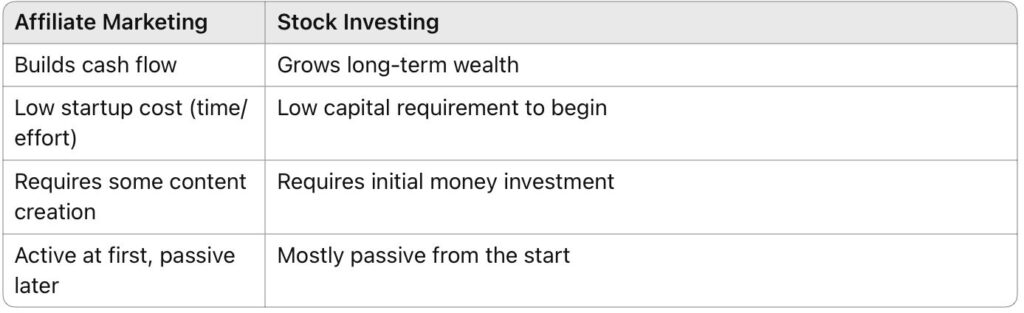
Affiliate Marketing + Stock Investing = A Smart Combo

Here’s how these two methods complement each other:

One creates cash you can use now. The other builds your future.

Even better: You can use affiliate earnings to fund your stock portfolio, speeding up your wealth-building process.

Busting Common Myths

Many professionals hesitate to start because of these limiting beliefs:

“I don’t have time.”

You don’t need hours a day. Just 30–45 focused minutes, a few times a week, can make a real difference.

“I’m not good with tech.”

Modern platforms are designed for beginners. You can use drag-and-drop tools like Canva, WordPress, or Systeme.io. No coding required.

“It’s probably a scam.”

Affiliate marketing is a legitimate business model used by Amazon, Shopee, Canva, and thousands of global companies. As for stocks, licensed brokers are regulated and safe to use—just avoid risky trading schemes.

“It’s too late for me to start.”

Whether you’re in your 30s, 40s, or 50s, it’s never too late to build something that gives you more options later in life. Start small, and stay consistent.

Getting Started: A Simple Beginner’s Plan

You don’t need a big budget or complicated strategy to begin. Here’s a basic roadmap:

Step 1: Choose Your Focus

  • Affiliate: Pick one product or niche you’re interested in
  • Stocks: Open an account with a trusted online broker

Step 2: Learn the Basics

  • Read blogs or watch YouTube tutorials
  • Follow beginner-friendly creators like Pat Flynn or Jeff Rose
  • Join online communities for support and accountability

Step 3: Start Small

  • Create your first blog post or video with an affiliate link
  • Invest your first small amount (even $10 or ₱500 is a great start)
  • Track progress weekly

Step 4: Build the Habit

• Block out 30 minutes a day or 2-3 hours per week

• Focus on consistency over perfection

• Celebrate small wins: your first click, first sale, or first dividend

Final Thoughts: Income That Works While You Do

Affiliate marketing and stock investing aren’t get-rich-quick schemes. They’re get-smart-slowly tools that help you build income and wealth in a way that aligns with your current responsibilities.

You don’t need to quit your job. You don’t need to be an expert.

But you do need to take the first step—and keep showing up consistently.

In a world where time is limited, building streams of income that don’t rely entirely on your daily labor is one of the smartest moves you can make.

Let your job be your base. Let online income be your boost.

Online Business Legal Basics: Registration, BIR, and Taxes in the Philippines

  • by docdoc

Are you starting a small online business or freelancing gig in the Philippines? That’s great! But wait—did you know you need to register with the government, even if you work from home?

This blog post will help you. We’ll break down the steps in easy words. You’ll learn how to register as a sole proprietor or freelancer, get a BIR TIN, and pay taxes properly. Let’s go!

Why Should You Register Your Online Business?

Before we start, here’s why registration is important:

✅ It’s required by law

✅ You can issue official receipts

✅ You can open business bank accounts

✅ You build trust with clients

✅ You avoid penalties and problems with the BIR

Whether you sell online, offer services, or do affiliate marketing, registration makes you legit.

Step 1: Choose Your Business Type

If you work alone, you have 2 options:

1. Freelancer (Professional)

You use your real name and register as a professional. Examples: writer, virtual assistant, designer, online coach.

2. Sole Proprietor

You register a business name and use it in your transactions. Examples: Ray’s Digital Hub, Marquez Online Services.

📌 Note: For both, you’ll still deal with the BIR and LGU, but the process is a bit different.

Step 2: Get a DTI Business Name (for Sole Proprietors Only)

If you choose to become a sole proprietor, you need a business name.

Where to go:

https://bnrs.dti.gov.ph

Steps:

1. Go to the DTI Business Name Registration System.

2. Search for your name idea.

3. Fill up the form.

4. Pay the fee (ranges from ₱200 to ₱2,000 depending on scope).

5. Download your certificate.

🟡 Skip this step if you’re registering as a freelancer using your real name.

Step 3: Barangay Clearance & Mayor’s Permit

Yes, even online businesses need these.

For both freelancers and sole proprietors:

Steps:

1. Go to your Barangay Hall.

2. Bring:

• 1 valid ID

• Proof of address (e.g., utility bill or lease)

• DTI Certificate (for sole proprietor only)

3. Pay the barangay fee (around ₱300–₱500).

4. Get Barangay Clearance.

Then go to your City/Municipal Hall to get a Mayor’s Permit.

Tips:

• Bring the Barangay Clearance.

• Additional documents may be asked (e.g., sketch of location, occupancy permit).

• Mayor’s Permit fees range from ₱1,000 to ₱5,000 depending on business type and location.

Step 4: Register with the BIR

Now it’s time to register with the Bureau of Internal Revenue (BIR). This is the most important step for taxes.

Go to the BIR Revenue District Office (RDO) where your business is located.

What to bring:

• Valid ID

• DTI Certificate (if applicable)

• Mayor’s Permit

• Barangay Clearance

• Proof of address

• BIR Form 1901 (for freelancers and sole proprietors)

• BIR Form 0605 (Payment Form – for the ₱500 registration fee)

📌 If you’re registering as a professional (freelancer), include your PRC ID or portfolio/resume.

Steps:

1. Fill up BIR Form 1901.

2. Pay ₱500 at the BIR-authorized bank using Form 0605.

3. Submit your documents to your RDO.

4. Attend the BIR taxpayer’s seminar (some RDOs may skip this).

5. Receive your:

• Certificate of Registration (COR)

• Ask permission to print official receipts or apply for “Non-VAT BIR Printed Receipts”

Step 5: Buy or Print Your Official Receipts

Once you’re registered with the BIR, you need to issue official receipts (ORs) to your clients.

You have 2 options:

 Apply for BIR Printed Receipts

• This is cheaper and faster.

• Use BIR-issued receipts valid for a year.

 Apply to Print Your Own Receipts

• More expensive and needs a printing permit.

• Ideal for businesses with branding needs.

You must also have:

Books of Accounts (you can use a notebook or buy from bookstores)

• Journal, Ledger, Cash Receipts

📌 Don’t forget to register your books at the BIR!

Step 6: File and Pay Your Taxes

Once registered, you must file tax returns, even if you don’t earn anything yet.

Common Taxes for Freelancers and Sole Proprietors:

✅ Quarterly Income Tax (BIR Form 1701Q)

✅ Annual Income Tax (BIR Form 1701)

✅ Quarterly Percentage Tax (BIR Form 2551Q)

✅ Withholding Tax (optional, if you hire staff)

🟡 Good news! If your income is under ₱250,000 per year, you may pay zero tax—but you still need to file.

Bonus Tip: Use an Online Tax Filing App

Filing taxes can be stressful. But good news: there are local tools that make it easier!

Try These:

Taxumo – User-friendly app for freelancers

JuanTax – For sole proprietors with VAT or more advanced needs

TaxWhizPH – Offers online consultations and support

📌 Some apps offer affiliate programs—perfect if you want to recommend them and earn on the side!

Setting Up a Home Office That Boosts Productivity

  • by docdoc

Affordable setup tips for small spaces with links to local stores in the Philippines.

Working from home is now common. But not everyone has a big space or a lot of money to set up a home office. Don’t worry! You can create a productive workspace even in a small area and on a budget. Let’s explore how.

1. Choose the Right Spot

Look around your home. Find a quiet corner or unused space. Even a small area can become your office.

Tips:

  • Use a corner in your bedroom.
  • Convert a part of your living room.
  • Utilize space under the stairs.

Example: PJ from the Philippines transformed a small nook in his bedroom into a functional workspace using a compact desk. 

2. Select Affordable Furniture

You don’t need expensive furniture. Look for budget-friendly options that fit your space.

Desks:

  • TORALD desk (65×40 cm) – ₱1,290.00 from IKEA.
  • Office Desk with Center and 3 Side Drawers, CNCI 125C – ₱3,600.00 from Cubix Office.

Chairs:

  • Marsail Ergonomic Office Chair – ₱7,478.83 from Amazon.

Local Stores:

  • Urban Concepts – Offers modern and affordable furniture.
  • SOGO Furniture – Known for everyday low prices.  
a desk with a laptop on it in front of a window
3. Organize with Smart Storage

Keep your workspace tidy with storage solutions.

Options:

  • SAMLA box clear – ₱50.00 from IKEA.
  • SKÅDIS pegboard (56×56 cm) – ₱900.00 from IKEA. 

Local Stores:

  • NITORI Philippines – Offers a range of storage furniture.  
4. Ensure Proper Lighting

Good lighting reduces eye strain and boosts productivity.

Options:

  • TERTIAL work lamp – ₱890.00 from IKEA.

Tip: Place your desk near a window to maximize natural light.

5. Personalize Your Space

Add personal touches to make your workspace inviting.

Ideas:

  • Use a comfortable chair cushion.
  • Add a small plant.
  • Hang motivational quotes.

Local Stores:

  • Anko – Offers affordable home decor items.  
Conclusion

Setting up a productive home office doesn’t require a lot of space or money. With the right choices, you can create a workspace that boosts your productivity.

Note: Prices and availability are subject to change. Please check the respective stores for the latest information.

Too Shy to Network? These 5 Simple Tricks Will Change That

  • by docdoc

Starting an online business can feel scary. You might think, “I’m too shy to talk to people.” But guess what? You don’t need to be super outgoing to build strong connections. You just need the right tools and a few smart tricks.

In this blog post, I’ll share 5 simple and real ways to network, even if you’re shy. These tips are easy to try, even from your own home. Plus, I’ll show you tools and websites you can use to grow your network—and even earn money from some of them!

1. Join Facebook Groups Where People Are Just Like You

The easiest way to meet other online entrepreneurs is by joining Facebook Groups. These are places where people share tips, ask questions, and help each other.

Example Groups You Can Join:

Online Filipino Entrepreneurs

Freelancers in the Philippines

Startup PH Community

What to Do:

Start by saying hello. You don’t need to be fancy. Just introduce yourself.

Sample Post:

“Hi! I’m [Your Name], just starting my online business. I’m excited to learn from everyone here!”

Tip: Try joining five groups this week and leave a comment on someone’s post each day.

2. Use LinkedIn to Find People Who Inspire You

LinkedIn is like Facebook, but for business people. You can follow others who already run online businesses and learn from their posts.

What to Do:

• Make a simple profile with your name and what you do.

• Follow 5–10 people in the online business world.

• Leave a kind comment or message.

Example Message:

“Hi, I loved your post about online selling. I’m starting out too and found it really helpful!”

Affiliate Tip: You can recommend tools on LinkedIn like Canva ProGrammarly, or Hostinger—and earn commissions through their affiliate programs.

3. Say “Thank You” or “That Helped Me!” More Often

One great way to network is by giving people positive feedback. When someone shares a helpful post, thank them. This opens up real conversations.

What to Say:

• “Thanks for sharing this! I tried your tip and it worked!”

• “This helped me understand email marketing better. I appreciate it!”

Why It Works:

It shows people that you’re paying attention and that you care. This makes them more likely to reply or even help you in return.

4. Attend Free Online Events and Webinars (You Don’t Need to Talk!)

Did you know you can join online events and learn for free? Many groups and websites offer free webinars about online business, freelancing, affiliate marketing, and more.

Where to Find Events:

Eventbrite.com (search “free webinars Philippines”)

Facebook Events

LinkedIn Live

Affiliate Tip:

When you attend events, you might learn about tools for email marketing like Systeme.io. These tools often have affiliate programs—so you can promote what you actually use!

5. Use a Networking Script So You Know What to Say

If you’re shy, it helps to have a script. This way, you don’t have to think of the right words on the spot.

Sample Script for Private Message:

“Hi! I saw your comment about affiliate marketing. I’m just starting out and would love to hear how you got started. Thanks!”

Sample Script for Public Post:

“Hey everyone! I’m learning about selling digital products online. Any tips for beginners?”

Bonus: Send me a message or appropriate comment and I will send you my free Networking Scripts Word file. :)

Quick Recap: The 5 Tricks for Shy Entrepreneurs

1. Join helpful Facebook Groups and introduce yourself

2. Follow inspiring people on LinkedIn

3. Say “thank you” often to start real conversations

4. Attend free webinars and online events

5. Use a script so you always know what to say

Final Thoughts

Being shy shouldn’t stop you from building your dream business. These small steps can lead to big results. The more people you know, the more chances you have to grow, learn, and even earn.

Remember: You don’t have to do everything at once. Start with one trick this week. You got this!

1M Followers? Here’s How WordPress Can Take You to 2M

  • by sdd ddd
people in building

Once upon a time, Mia, a rising influencer with 1M followers, hit a wall. She was posting daily on Instagram, TikTok, and YouTube, but her growth had stalled. Her followers loved her content, but she felt like she was stuck in a loop—constantly chasing algorithms and losing sleep over engagement metrics. Her social media platforms were unpredictable. One day, her video would go viral; the next, it would flop. She had no control over her audience’s experience, and worse, she couldn’t monetize her content effectively. Brands were hesitant to collaborate because she didn’t have a professional hub to showcase her work. Her dream of turning her influence into a full-time career felt further away than ever.

Every time Mia tried to brainstorm solutions, she felt overwhelmed. Should she switch platforms? Invest in ads? Hire a manager? The options were endless, but none gave her the control she craved. She watched other influencers soar past 2M followers while she remained stuck, wondering what she was missing.

Then, Mia discovered WordPress. She built a stunning website that became the heart of her brand. It showcased her best content, linked to her social media, and even had a store where she sold her merch. With SEO plugins, her site started ranking on Google, bringing in new followers she’d never reach on social media alone. WordPress gave her control, stability, and a way to connect directly with her audience. Within months, her follower count skyrocketed—and she didn’t just hit 2M, she blew past it.

Mia’s story isn’t unique. If you’re an influencer with 1M followers and feel like you’re hitting a ceiling, WordPress could be the game-changer you’ve been waiting for. Ready to take the leap? Let’s dive into how WordPress can take you to 2M—and beyond.


10 Questions 1M influencers Ask About WordPress Websites

1. What’s the difference between WordPress.com and WordPress.org?

WordPress.com is like renting a house 🏠—you have limited control. WordPress.org is like owning a house 🏡—you can do anything you want!

  • WordPress.com: Hosted for you, but limited plugins and themes.
  • WordPress.org: Full control, but you need to handle hosting.

2. How do I install a WordPress theme?

Themes are like outfits for your website 👗. You can:

  • Use the WordPress dashboard to install free themes.
  • Upload premium themes via a ZIP file.

3. What are the best plugins for influencers?

Plugins are like apps for your website 📱. Here are some must-haves:

  • YoastSEO: Helps with search engine optimization.
  • Smash Balloon: Displays social media feeds.
  • Ultimate Blocks: Enhances content creation.

4. How do I add a contact form?

Contact forms are like mailboxes 📬. Use plugins like WPForms to:

  • Drag and drop fields.
  • Publish forms on your pages.

5. Can I monetize my WordPress site?

Yes! 💰 Use plugins like Easy Digital Downloads to sell digital products or WooCommerce for physical goods. Make sure you connect your WordPress to an email + ecommerce platform like systeme.

6. How do I improve my site’s SEO?

SEO is like a treasure map 🗺️. Follow these tips:

  • Use YoastSEO.
  • Write click-worthy titles.
  • Add alt text to images.

7. What are the limitations of WordPress?

WordPress is amazing but has some limits ⛔:

  • Too many plugins can slow your site.
  • Premium themes and plugins can be expensive.

8. How do I start an online store?

Selling online is like opening a shop 🛍️. Follow these steps:

  1. Set up your WordPress site.
  2. Install an eCommerce plugin like Easy Digital Downloads.

9. How do I keep my site secure?

Security is like a lock 🔒. Use plugins like Wordfence to:

  • Block hackers.
  • Scan for malware.

10. How do I make my site visually appealing?

Design is like art 🎨. Use themes and plugins to:

  • Add social media feeds.
  • Create interactive content like countdown timers.

Comparison Table: WordPress.com vs WordPress.org

FeatureWordPress.comWordPress.org
HostingIncludedYou need to arrange
PluginsLimitedUnlimited
MonetizationRestrictedFull control
CostFree plan availableRequires hosting fees

At the end of her journey, Mia built a stunning WordPress website that wowed her followers. 🌟 She shared her story and tips, inspiring others to start their own websites. And they all lived happily ever after! 🎉

Now it’s your turn! Click here to get started on your first step to building your WordPress website 🚀

My recommended wordpress provider is here.

Citations:

  1. https://www.shiksha.com/online-courses/articles/wordpress-interview-questions/
  2. https://www.modash.io/blog/questions-to-ask-influencers
  3. https://www.hostinger.ph/tutorials/best-wordpress-plugins
  4. https://ahrefs.com/blog/wordpress-seo/
  5. https://www.monsterinsights.com/how-to-create-a-contact-form-in-wordpress-the-simple-way/
  6. https://easydigitaldownloads.com/blog/how-to-start-an-online-store-with-wordpress-best-way/
  7. https://www.hostinger.my/tutorials/how-to-install-wordpress-themes
  8. https://pressbooks.bccampus.ca/technicalwriting/chapter/figurestables/
  9. https://leverageedu.com/blog/article-writing/
  10. https://opentextbc.ca/technicalwritingh5p/chapter/writing-comparisons/
  11. https://qodeinteractive.com/magazine/most-frequently-asked-questions-about-wordpress/
  12. https://themeisle.com/blog/must-have-wordpress-plugins-for-bloggers/
  13. https://blog.wordvice.com/how-to-use-graphs-tables-in-a-research-paper/
  14. https://www.open.edu/openlearn/ocw/mod/oucontent/view.php?id=85815§ion=5.4
  15. https://www.wpbeginner.com/beginners-guide/15-most-frequently-asked-questions-by-wordpress-beginners/
  16. https://sproutsocial.com/insights/social-media-questions/
  17. https://pictelate.com/blog/f/social-media-influencer-qa-top-search-engine-questions
  18. https://www.bluehost.com/blog/influencer-marketing/
  19. https://www.wpbeginner.com/beginners-guide/how-to-create-a-contact-form-in-wordpress/
  20. https://www.liquidweb.com/wordpress/ecommerce/how-to-create-wordpress-store/
  21. https://www.wpbeginner.com/beginners-guide/how-to-install-a-wordpress-theme/
  22. https://blog.hubspot.com/marketing/wordpress-seo
  23. https://www.enago.com/academy/enhancing-research-articles-with-tables-and-figures/
  24. https://writingcenter.uci.edu/2024/04/29/the-dos-and-donts-of-using-tables-and-figures-in-your-writing/
  25. https://literacyideas.com/how-to-write-an-article/
  26. https://www.scribbr.com/dissertation/figure-and-table-lists-in-your-dissertation/
  27. https://nexterwp.com/blog/top-wordpress-influencers-to-follow/
  28. https://hivepress.io/blog/influencer-marketing-platform-with-wordpress/
  29. https://www.orbitmedia.com/blog/seo-influencer-marketing/
  30. https://www.imforza.com/blog/questions-to-ask-your-wordpress-developer/
  31. https://world.siteground.com/tutorials/wordpress/install-themes/
  32. https://www.hostinger.com/ph/tutorials/wordpress-seo-tips
  33. https://academicguides.waldenu.edu/writingcenter/writingprocess/comparecontrast
  34. https://www.youtube.com/watch?v=axjUhtr6Sz8
  35. https://www.grammarly.com/blog/writing-tips/news-article/

The Professional’s Guide to Efficiently Scaling Your Side Hustle into a Full-Time Business

  • by sdd ddd

Transitioning a side hustle into a full-time business is a dream for many professionals seeking financial freedom without immediately risking their primary careers. Achieving this requires a focus on efficiency, scalability, and strategic planning. Here’s a guide to help you navigate this transition effectively.

1. Develop a Scalable Business Model

A scalable business model is essential for growth. It allows your business to expand without a proportional increase in costs. Focus on creating products or services that can be replicated or delivered to a larger audience with minimal additional effort.

Strategies:

Digital Products: Create e-books, online courses, or software that can be sold repeatedly without significant additional costs.

Subscription Services: Offer memberships or subscription-based services to ensure recurring revenue.

Example: An entrepreneur who started with a single online course expanded into a library of courses with a subscription model, significantly increasing revenue without a proportional increase in workload.

2. Automate and Outsource Tasks

Efficiency is key when balancing a side hustle with a full-time job. Automating repetitive tasks and outsourcing non-core activities can free up valuable time.

Automation Tools:

Systeme.io * is an all-in-one automation tool that streamlines online business operations by integrating sales funnels, email marketing, course creation, and affiliate management into a single platform.

Social Media Scheduling: Tools like Buffer or Hootsuite can schedule posts in advance, maintaining an active online presence without daily effort.

Outsourcing Options:

Virtual Assistants: Hire freelancers to handle administrative tasks, customer service, or content creation.

Example: A professional outsourced graphic design tasks to freelancers, allowing more focus on strategic growth initiatives.

3. Implement Efficient Time Management

Balancing a side hustle with a career requires meticulous time management. Allocating specific time blocks for business activities ensures consistent progress.

Techniques:

Time Blocking: Dedicate specific hours to business tasks, minimizing distractions.

Prioritization: Focus on high-impact tasks that drive growth, delegating or postponing less critical activities.

Example: An individual allocated early morning hours to their side business, ensuring uninterrupted time before the demands of the day began.

4. Validate Your Business Idea

Before fully committing, validate your business idea to ensure market demand. This reduces risk and confirms the potential for scalability.

Methods:

Minimum Viable Product (MVP): Launch a simplified version of your product or service to gauge interest.

Market Research: Conduct surveys or focus groups to gather feedback from your target audience.

Example: A professional launched a basic version of their app to test user interest before investing in full development.

5. Establish a Strong Online Presence

A robust online presence enhances credibility and expands reach. Utilize digital platforms to showcase your expertise and connect with potential customers.

Strategies:

Professional Website: Develop a user-friendly website that highlights your offerings and includes testimonials.

Content Marketing: Create valuable content, such as blogs or videos, to attract and engage your audience.

Example: An entrepreneur consistently published informative articles on their website, driving organic traffic and establishing authority in their niche.

6. Monitor Financial Performance

Understanding your financial metrics is crucial for sustainable growth. Regularly monitor income, expenses, and profitability to make informed decisions.

Tools:

Accounting Software: Utilize platforms like QuickBooks or Xero for accurate financial tracking.

Financial Planning: Develop budgets and financial projections to guide business decisions.

Example: A side hustler used accounting software to identify unnecessary expenses, improving profitability and cash flow.

7. Plan the Transition Carefully

Transitioning from a side hustle to a full-time business requires strategic planning to mitigate risks.

Considerations:

Financial Cushion: Ensure you have sufficient savings to cover personal expenses during the transition.

Exit Strategy: Plan your departure from your current job professionally, maintaining relationships and leaving the door open for future opportunities.

Example: An individual saved six months’ worth of living expenses before transitioning, providing financial security during the initial full-time phase of their business.

Conclusion

Scaling your side hustle into a full-time business is achievable with a focus on efficiency, scalability, and strategic planning. By implementing these strategies, professionals can pursue financial freedom while minimizing risks to their primary careers.

* Please note that as an affiliate, I may receive a commission if you make a purchase through the links on this page at no extra cost to you.

The Best Tools & Resources for Busy Professionals Starting an Online Business

  • by sdd ddd

Starting an online business as a busy professional is no easy task. You’re already juggling work, family, and personal time, so how do you find the energy to build something on the side?

I know the struggle because I’ve been there. When I started my online business, I needed tools that would save time, automate tasks, and make the process easier. I didn’t want to waste hours figuring things out—I needed straightforward, effective solutions.

If you’re serious about building an online business while working full-time, these are the best tools and resources that helped me get started without feeling overwhelmed.

1. Website & Hosting Tools

Your website is your online home. Whether you’re starting a blog, affiliate marketing site, or an e-commerce store, you need a fast, reliable, and easy-to-use website.

Best Website Builders & Hosting:

✔ WordPress + Hostinger * – Best for blogs and affiliate sites

✔ Shopify – Best for selling physical or digital products

✔ Carrd – Best for quick landing pages

I personally use WordPress with Hostinger because it’s affordable, easy to set up, and SEO-friendly. Plus, you own your site, which gives you more control.

Pro Tip: Don’t overthink your website design. A simple, clean site with great content is all you need to start.

2. Content Creation & SEO Tools

If you want people to find your business online, you need to create helpful, searchable content. Whether it’s blog posts, YouTube videos, or social media content, these tools make it easier:

Best Content Creation Tools:

✔ Canva – Design beautiful graphics without needing design skills

✔ Grammarly – Fix grammar mistakes in blog posts and emails

✔ Pexels & Unsplash – Get free high-quality images

Best SEO Tools:

✔ Ubersuggest – Find keywords people are searching for

✔ Google Keyword Planner – Free tool to check search volume

✔ Rank Math – A WordPress SEO plugin to optimize your posts

When I started, I had zero knowledge of SEO, but using Ubersuggest helped me find low-competition keywords, making it easier to rank on Google.

Pro Tip: Focus on long-tail keywords (like “best online side hustles for doctors”) instead of broad ones (like “side hustles”). They are easier to rank for and bring targeted traffic.

3. Email Marketing & Lead Generation

One of my biggest mistakes when starting out was not collecting emails from day one. If you rely only on social media, you don’t own your audience. Email marketing helps you build a loyal following that you control.

Best Email Marketing Tools:

✔ ConvertKit – Best for beginners who want simple automation

✔ Mailchimp – Good free option for small email lists

✔ MailerLite – Easy-to-use and affordable

Best Lead Generation Tools:

✔ OptinMonster – Create pop-ups and forms to collect emails

✔ Beacon – Make beautiful lead magnets (like PDFs and guides)

Pro Tip: Offer a freebie (like a checklist or guide) to encourage people to sign up for your email list.

4. Social Media & Scheduling Tools

If you’re growing your business while working full-time, you don’t have hours to spend on social media. That’s where scheduling tools come in.

Best Social Media Tools:

✔ Buffer – Schedule posts on multiple platforms

✔ Hootsuite – Manage all social media accounts in one place

✔ Later – Great for Instagram scheduling

Instead of posting manually every day, I schedule a week’s worth of content in one sitting. It saves so much time!

Pro Tip: Focus on one or two platforms instead of trying to be everywhere. If your audience is on LinkedIn or Instagram, start there.

5. Business & Productivity Tools

Staying organized is key when running a business on the side. These tools help you manage your time and tasks without getting overwhelmed.

Best Productivity Tools:

✔ Trello – Organize tasks and track progress

✔ Notion – Take notes and plan content

✔ Google Calendar – Schedule work time for your business

I personally love Trello because I can break down big projects into small tasks, making everything less overwhelming.

Best Automation Tools:

✔ Zapier – Connect apps and automate tasks

✔ Calendly – Schedule meetings without back-and-forth emails

Pro Tip: Block out time on your calendar for your business. Even just 5-10 hours per week can make a huge difference.

6. Financial & Payment Tools

If you’re making money online, you need a way to track earnings and get paid. These tools help:

Best Payment & Accounting Tools:

✔ PayPal – Easy way to receive payments worldwide

✔ Stripe – Best for online stores and selling services

✔ Wave – Free accounting tool for tracking income & expenses

I use PayPal because it’s widely accepted and easy to use.

Pro Tip: Separate your business finances from personal ones. Open a business PayPal or bank account to keep things organized.

* Please note that as an affiliate, I may receive a commission if you make a purchase through the links on this page at no extra cost to you.

Final Thoughts: The Right Tools Make Business Easier

As a busy professional, you don’t have time to waste. The right tools can automate tasks, improve productivity, and help you grow your online business faster.

✅ Start with a simple website (WordPress or Shopify)

✅ Use SEO tools to get organic traffic

✅ Automate email marketing to grow your audience

✅ Schedule social media posts to save time

✅ Stay organized with Trello or Google Calendar

✅ Track your income with Wave or PayPal

You don’t need every tool—start with the basics and add more as you grow.

What’s your favorite tool for running an online business? Let me know in the comments!

How to Validate an Online Business Idea Before Investing Your Valuable Time

  • by sdd ddd

Starting an online business is exciting. You have an idea, and you can’t wait to get started. But before you spend months building something, how do you know if your idea will actually make money?

I’ve been there. When I first started my online business journey, I jumped into ideas without testing them. Some flopped, and I wasted valuable time. I learned the hard way that validating an idea first can save you months—or even years—of frustration.

So, how do you test your online business idea before going all in? Let me walk you through the process.

Why Validation Matters

Imagine spending six months creating an online course or website, only to realize that nobody wants it. That’s why validation is key. It helps you:

✅ Avoid wasting time on bad ideas

✅ Find out if people will actually pay

✅ Adjust your idea before it’s too late

If your idea is good, people will show interest early on—even before you launch.

red white and black round wheel
Step 1: Identify Your Target Audience

Who are you trying to serve? This is the first question to ask before starting an online business. If you try to sell to “everyone,” you’ll sell to no one.

How to Find Your Target Audience:

✔ Think about their problems: What challenges do they face?

✔ Consider their interests: What do they search for online?

✔ Look at competitors: Who are they targeting?

For example, when I wanted to start an affiliate marketing website, I first identified who needed the information I wanted to share. I focused on newbie online entrepreneurs who wanted to build income streams.

Once you have a clear audience, move on to testing your idea.

Step 2: Check If People Are Searching for Your Idea

A quick way to validate an idea is by checking if people are already looking for it online.

Tools to Use 

Google Trends: See if search interest is growing or dying.

Ubersuggest or Ahrefs: Find out how many people search for your topic.

Reddit & Quora: Check if people ask questions about your idea.

When I researched “best online side hustles for professionals”, I saw thousands of searches per month. That told me there was real demand.

If nobody is searching for your idea, you might need to adjust it or pick a different one.

Step 3: Spy on Your Competition

Competition is a good thing—it means money is being made.

How to Analyze Your Competitors:

✔ Search your business idea on Google and see what comes up.

✔ Check social media to see if people engage with similar businesses.

✔ Look at what they sell—are people buying their products or services?

When I started my website, I analyzed other online entrepreneurs in my niche. I noticed they had active blogs, courses, and affiliate links, which meant there was money to be made.

If you can’t find any competition, it might mean there’s no demand.

Step 4: Ask People for Feedback

One of the best ways to validate a business idea is by asking real people.

Ways to Get Feedback:

Join Facebook Groups related to your niche and ask questions.

Post on Reddit or Quora and see if people respond.

Talk to potential customers (friends, colleagues, online communities).

When I had an idea for a financial literacy website, I asked in a Facebook group, “Would you be interested in a site that teaches step-by-step ways to earn passive income?” The responses were positive, so I knew I was on the right track.

If people don’t seem interested, you may need to adjust your approach.

Step 5: Create a Simple Landing Page

Instead of building a full website, create a simple landing page to see if people sign up or show interest.

What to Include on Your Page:

✔ A headline that explains your idea

✔ A short description of what you offer

✔ A call-to-action (join a waitlist, download a freebie, etc.)

Use tools like Carrd, WordPress, or ConvertKit to set it up in minutes.

When I tested an idea for a side hustle guide, I created a basic page and offered a free PDF. If people signed up, I knew they were interested. If not, I knew I had to tweak my idea.

Step 6: Pre-Sell Your Offer

The ultimate validation is when someone pays you before you fully launch.

How to Pre-Sell Your Idea:

• Offer discounted early access to your product/service.

• Create a small version of your product and sell it.

• Run a beta test and charge a small fee.

If people are willing to pay, it means your idea is worth pursuing.

When I launched my first affiliate site, I didn’t wait to get everything perfect. I published a few articles and added affiliate links. Once I saw traffic and small commissions, I knew I could scale it.

Step 7: Track Results & Adjust

If you test your idea and see little interest, don’t give up! Sometimes, you just need to tweak your approach.

What to Look For:

✔ Are people searching for your idea online?

✔ Did people engage when you asked for feedback?

✔ Did anyone sign up or pre-order?

If the answer is yes, move forward and start building your business! If not, adjust and retest.

Final Thoughts: Validate First, Then Build

If I could go back in time, I’d tell myself not to rush into an idea without testing it.

✅ Check if people are searching for your idea.

✅ Look at competitors to see if money is being made.

✅ Ask real people for feedback.

✅ Set up a landing page to measure interest.

✅ Try to pre-sell your idea before fully launching.

Validating your business before investing months of work will save you time, money, and frustration.

Have you validated your online business idea? Share your experience in the comments!

7 Mistakes Professionals Make When Starting an Online Business (And How to Avoid Them)

  • by sdd ddd

Starting an online business while working full-time is exciting but also challenging. I know this because I’ve been there. As a professional, I wanted to build a side hustle that could eventually replace my income, but I quickly realized that some common mistakes can slow you down—or even cause you to quit too soon.

If you’re thinking about starting an online business, learn from these 7 mistakes I made (or almost made!) and how you can avoid them.

brown wooden letter letter letter blocks
1. Overthinking and Never Starting

When I first decided to start an online business, I spent weeks researching and trying to find the “perfect” business model. I read countless articles, watched YouTube videos, and analyzed different strategies. But guess what? I wasn’t taking action.

Why This Is a Mistake

• You waste valuable time overthinking instead of actually starting.

• You don’t learn until you take action and adjust as you go.

• There’s no perfect business model—you have to pick one and go for it.

How to Avoid It:

✔ Pick one business model (affiliate marketing, freelancing, digital products, etc.).

✔ Set a 30-day goal to launch something, even if it’s small.

✔ Learn as you go—your business will evolve over time.

2. Trying to Do Everything at Once

At first, I thought I needed to be everywhere—YouTube, Instagram, Facebook, TikTok, and a blog. I was trying to create content for every platform, and it quickly became overwhelming.

Why This Is a Mistake:

• Spreading yourself too thin leads to burnout.

• You won’t master any platform if you try to do them all.

• It’s better to focus on one platform and grow from there.

How to Avoid It:

✔ Choose one main platform (blog, YouTube, or social media).

✔ Focus on consistent, high-quality content instead of quantity.

✔ Once you see success, expand to other platforms.

3. Spending Too Much Money Too Soon

I was tempted to buy fancy website themes, expensive tools, and premium courses before even making my first dollar. While investing in your business is important, spending too much too early can backfire.

Why This Is a Mistake:

• You don’t need a big budget to start an online business.

• Many free or low-cost tools can help you launch.

• If you don’t earn income first, you might waste money on things you don’t need.

How to Avoid It:

✔ Start lean—use free or low-cost tools (WordPress, Canva, Mailchimp).

✔ Invest only when necessary (e.g., a domain name, basic hosting).

✔ Once your business earns money, reinvest in growth.

4. Ignoring SEO and Organic Traffic

At first, I focused only on social media to drive traffic. I posted daily, hoping to get likes and followers, but I noticed my traffic dropped whenever I stopped posting. That’s when I realized I needed a long-term traffic strategy.

Why This Is a Mistake:

• Social media traffic disappears fast if you stop posting.

• SEO (search engine optimization) brings consistent, free traffic.

• A well-optimized blog or YouTube channel can generate income for years.

How to Avoid It:

✔ Learn basic SEO (keyword research, backlinks, on-page optimization).

✔ Focus on creating evergreen content that ranks on Google.

✔ Use a mix of social media for quick traffic and SEO for long-term growth.

5. Not Building an Email List from Day One

One of my biggest regrets was not collecting emails from the start. I thought email marketing was old-school, but I quickly learned that an email list is your most valuable asset.

Why This Is a Mistake:

• Social media platforms can change or ban your account, but you own your email list.

• Email subscribers are more likely to buy than social media followers.

• It’s the best way to build a long-term relationship with your audience.

How to Avoid It:

✔ Set up a simple email opt-in form on your website.

✔ Offer a freebie (ebook, checklist, or discount) to encourage sign-ups.

✔ Use tools like ConvertKit or Mailchimp to automate emails.

6. Giving Up Too Soon

When I didn’t see quick results, I started doubting myself. I wondered if my niche was wrongor if I should try something else. Many online entrepreneurs quit too soon because they expect overnight success.

Why This Is a Mistake:

• Building a profitable online business takes time.

• It often takes months before you see significant results.

• Success comes from consistent effort, not luck.

How to Avoid It:

✔ Set realistic goals (e.g., “Make $500 in 6 months”).

✔ Track small wins—even getting one sale or email sign-up is progress.

✔ Remember, every successful entrepreneur started small.

7. Not Treating It Like a Real Business

At first, I treated my online business like a hobby—I worked on it when I felt like it instead of setting a schedule. That slowed down my progress.

Why This Is a Mistake:

• A business requires commitment and discipline.

• If you don’t take it seriously, it won’t grow into a full-time income.

• Small consistent actions lead to big results.

How to Avoid It:

✔ Set dedicated work hours for your business (even if it’s just 5-10 hours/week).

✔ Track progress and income goals like a real business.

✔ Remember, even a side hustle can become a full-time income if you stay consistent.

Final Thoughts: Learn from My Mistakes & Build a Profitable Business

Starting an online business while working full-time is challenging but possible. If you avoid these mistakes, you’ll save time, money, and frustration.

✅ Take action instead of overthinking.

✅ Focus on one platform instead of spreading too thin.

✅ Start lean and reinvest as you grow.

✅ Use SEO and email marketing for long-term success.

✅ Stay patient and consistent—results take time.

If you’re serious about building an online business that lasts, learn from my mistakes and take action today!

What mistake have you made (or almost made) in your online business? Let me know in the comments!

How to Start and Grow an Online Business Without Quitting Your Job (Yet!)

  • by sdd ddd

Starting an online business while working a full-time job can feel overwhelming. You may wonder

How do I find time to build a business?

Can I grow it while working 9 to 5?

When should I think about quitting my job?

The good news is many successful online entrepreneurs started as side hustlers. You don’t need to quit your job right away. Instead, you can start small, build gradually, and transition when the time is right

In this guide, you’ll learn how to balance your job and online businessavoid burnout, and set up a plan for success.

Why You Should Keep Your Job (At First!)

Quitting your job too soon can be risky. Here’s why keeping your 9-to-5 while building your online business is a smart move:

✅ Financial Security – Your job pays the bills while your business grows.

✅ Less Pressure – You don’t have to rush into making money immediately.

✅ More Flexibility – You can experiment, test ideas, and refine your strategy.

Once your business earns a stable income, you can decide if you want to go full-time.

Now, let’s look at how to start your business while working full-time.

1. Choose the Right Business Model

Some businesses require less time and upfront investment, making them ideal for side hustlers. Here are a few good options:

 Affiliate Marketing
woman wearing eyeglasses

• Promote products on a blog, YouTube, or social media.

• Earn commissions when people buy through your link.

• Great for passive income once you build traffic.

 Selling Digital Products
text

• Create and sell ebooks, templates, or online courses.

• Requires one-time effort, but can sell over and over.

• Works well if you have expertise in a niche.

 Freelancing
man in black shirt sitting in front of computer

• Offer writing, graphic design, consulting, or coding services.

• Earn money immediately by working with clients.

• Best for professionals looking for quick income.

 Print-on-Demand or Dropshipping
brown cardboard box on white table

• Sell custom-designed products without inventory.

• A great option if you love design or e-commerce.

• Works well with automated systems.

Choose a model that fits your skills, time, and income goals.

2. Create a Simple Business Plan

You don’t need a 50-page business plan. A simple plan will help you stay focused. Answer these questions:

What product or service will I offer?

How much time can I commit each week?

How will I attract customers or traffic?

What are my income goals?

A clear plan helps you stay on track and avoid distractions.

3. Set a Realistic Schedule

Balancing a job and business means managing your time wisely.

Time-Saving Tips:

✔ Use Early Mornings or Evenings – Work on your business before or after your job.

✔ Dedicate Weekends – Spend a few hours on content creation or marketing.

✔ Batch Tasks – Write blog posts, schedule social media, and create content in batches.

✔ Use Productivity Tools – AI tools like ChatGPT, Canva, and Trello help you save time.

Even 5-10 hours per week can make a difference!

4. Automate & Outsource to Save Time

If you have limited hours, use automation and outsourcing to speed things up.

Automation Tools:

Email Marketing: ConvertKit or Mailchimp for automated emails.

Social Media Scheduling: Buffer or Later to schedule posts.

AI Writing Tools: ChatGPT or Jasper for content creation.

Outsourcing Tasks:

If you can afford it, hire freelancers on Fiverr or Upwork for:

✔ Logo design

✔ Website setup

✔ Content writing

The less manual work you do, the faster your business grows.

5. Start Small, But Stay Consistent

Many side hustlers give up too soon because they don’t see quick results.

✔ Set small, achievable goals. Example: “Write 2 blog posts per month.”

✔ Track progress. Keep a simple spreadsheet to measure growth.

✔ Stay consistent. Even slow progress adds up over time.

Think of it like building a muscle—small efforts daily lead to big results later!

6. When Should You Consider Quitting Your Job?

If your online business starts making money, you may wonder: When is the right time to go full-time?

Here are key signs you’re ready:

✔ Your business earns at least 50-70% of your full-time salary.

✔ You have at least 6 months of savings as a safety net.

✔ Your business has stable income growth (not just a one-time spike).

✔ You’re running out of time to grow because your job takes up too much of it.

Pro Tip: You don’t have to quit cold turkey—you can switch to part-time work first before going all-in.

Final Thoughts: Build Your Business Without Risking Your Job

Starting an online business while working full-time is challenging but possible.

✅ Choose a low-risk, scalable business model

✅ Use automation and productivity tools to save time

✅ Stay consistent, even if it’s just a few hours a week

✅ Grow your income before quitting your job

Many successful entrepreneurs started as side hustlers. You don’t need to rush—start small, grow smart, and build a future where you can be your own boss!

What online business are you starting? Let me know in the comments!

How to Choose the Right Online Business Model While Working Full-Time

  • by sdd ddd

Starting an online business while working full-time can feel overwhelming. You may be wondering..

What type of business should I start?

How can I grow it while working a 9-to-5?

Which business model makes sense for someone with limited time?

The good news is many online business models can work as a side hustle. You don’t need to quit your job right away. Instead, you can start small, grow your income, and eventually decide if you want to go full-time.

In this guide, we’ll cover the best online business models for busy professionals, how to choose the right one for you, and how to start with minimal risk.

Why Choosing the Right Business Model Matters

Not all online businesses are the same. Some require more time, money, and effort than others. If you’re working full-time, you need a scalable, flexible, and low-maintenancebusiness model.

A good side hustle should:

✅ Fit into your busy schedule

✅ Have low startup costs

✅ Allow you to start small and grow over time

✅ Be scalable so you can eventually earn passive income

black and white Hustle-printed ceramic mug on table

Now, let’s explore some of the best online business models for working professionals.

1. Affiliate Marketing – Best for Passive Income

Affiliate marketing is one of the best online businesses for busy professionals. It allows you to earn commissions by promoting other people’s products.

How It Works:

• You create a website, blog, or social media account.

• You promote affiliate products (like Amazon, software, or online courses).

• When someone buys through your link, you earn a commission.

Pros:

✔ Low-cost startup (all you need is a website)

✔ No need to create products

✔ Can generate passive income over time

Cons:

❌ Takes time to build an audience

❌ Income is not instant; requires content creation

Best for:

People who enjoy writing, blogging, or making videos about topics they love.

2. Selling Digital Products – Best for Scalability

Selling digital products is a great way to make money online because you create a product once and sell it over and over.

How It Works:

• Create ebooks, templates, courses, or printables.

• Sell them on your website, Gumroad, Etsy, or Shopify.

• Customers download them instantly, and you earn 100% profit.

Pros:

✔ Scalable (sell without extra work)

✔ No shipping or inventory

✔ Can be automated for passive income

Cons:

❌ Requires time upfront to create the product

❌ Need a marketing plan to attract buyers

Best for:

Professionals with expertise in a field who can create guides, courses, or templates.

3. Freelancing – Best for Quick Cash

Freelancing lets you offer your skills online and get paid per project. If you have experience in writing, graphic design, programming, or marketing, freelancing can be a fast way to earn money.

How It Works:

• Create a profile on Upwork, Fiverr, or Freelancer.

• Offer services like writing, web design, or consulting.

• Get paid for completed projects.

Pros:

✔ Quick way to start making money

✔ No need for a website or audience

✔ Can turn into a full-time business

Cons:

❌ Not passive income (you trade time for money)

❌ Requires consistent client work

Best for:

People who want fast income while building another business.

4. Print-on-Demand (POD) and Dropshipping – Best for E-Commerce Without Inventory

Print-on-demand and dropshipping allow you to sell products online without handling inventory.

How It Works:

• You set up an online store (using Shopify, Etsy, or Redbubble).

• Customers buy t-shirts, mugs, or accessories with your design.

• A supplier prints and ships the product for you.

Pros:

✔ No inventory, no storage needed

✔ Can be automated

✔ Great for creative professionals

Cons:

❌ Profit margins are lower

❌ Need good marketing to drive sales

Best for:

People who love design, branding, and e-commerce.

How to Choose the Right Online Business Model

Now that you know the best options, which one is right for you?

Ask yourself:

✅ How much time do I have? (1-2 hours/day? Weekends only?)

✅ What skills do I already have? (Writing? Design? Teaching?)

✅ How much money can I invest upfront? (Low-cost vs. high-investment)

✅ Do I want passive income or quick cash? (Long-term vs. short-term)

Quick Recommendations:

👉 Want passive income? → Affiliate marketing or selling digital products

👉 Need fast cash? → Freelancing

👉 Love design and branding? → Print-on-demand

How to Start Your Online Business as a Side Hustle

Once you choose a business model, follow these simple steps:

Step 1: Research and Plan

• Pick a niche you enjoy and has profit potential.

• Study competitors to see what works.

Step 2: Set Up Your Business

• Register a website or social media page.

• Set up affiliate accounts, a store, or a freelancing profile.

Step 3: Start Small and Scale

• Spend 1-2 hours per day creating content or finding clients.

• Automate tasks using AI tools and scheduling apps.

Step 4: Grow and Monetize

• Build an audience through SEO, blogging, or social media.

• Use email marketing to turn visitors into customers.

Final Thoughts: Start Now, Grow Later

Starting an online business while working full-time is possible—you just need the right strategy.

✅ Choose a business model that fits your schedule

✅ Start small and grow over time

✅ Focus on automation and scalability

The key is to start now, even if it’s small. Over time, your side hustle can become a full-time income.

What business model are you considering? Let me know in the comments!

Leave a Reply

Your email address will not be published. Required fields are marked *

More income, less stress. Want guidance?

X